A New Draft?
I Predicted It—And Was Wrong. Sort Of.

By Chuck Fager
Today, many of my friends have an addition to their already lengthy worry lists: automatic draft registration.
A week before last Christmas, the president signed a law which, among other holiday surprises, decreed that by December of 2026, draft registration for 18-year-old American males will become automatic.
Inasmuch as my friends are mostly of a certain age (or past it) the anxiety is not for themselves, but for grandsons, grand-nephews, or grand-cousins. The worriers may be too old to be conscripted. But most have memories of the Vietnam War’s ten dismal years.
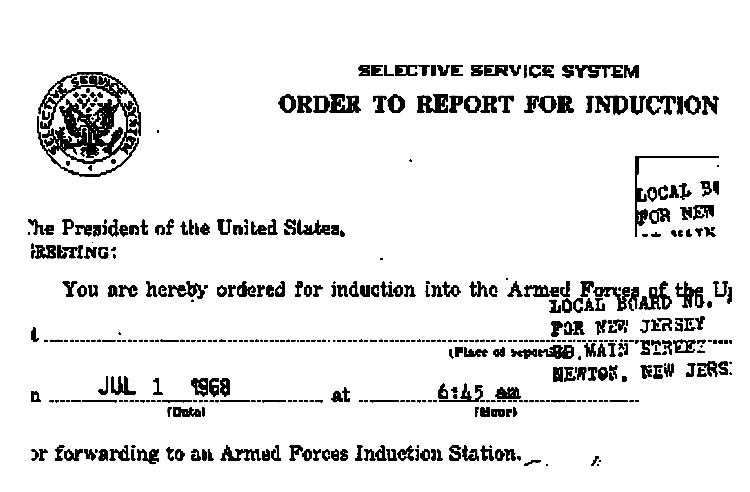
Talk of the military draft, which was an engine of the Vietnam War’s fearful human cost (58,000 Americans dead, millions wounded or burdened with PTSD and more; years of social turmoil) triggers many traumatic flashbacks—and now one in particular:
Is the draft now likely to return?
Back in 2003, as the Iraq War loomed, I thought so. I wrote an essay predicting the United States would eventually bring back the military draft.
I was wrong.
The Iraq and Afghanistan wars went on for 20 years. The draft did not return.
Yet looking back, while my prediction missed, my case for it was mostly on target. The problems I thought I saw were real. What I got wrong was how the military and political system would deal with it.
In 2003 I drew a simple graph. It showed two lines moving steadily apart. One line, nearly flat, represented the supply of military personnel. The other, slanting up, was the growing demand for troops created by new wars, occupations, homeland-security missions, and America’s expanding global commitments.
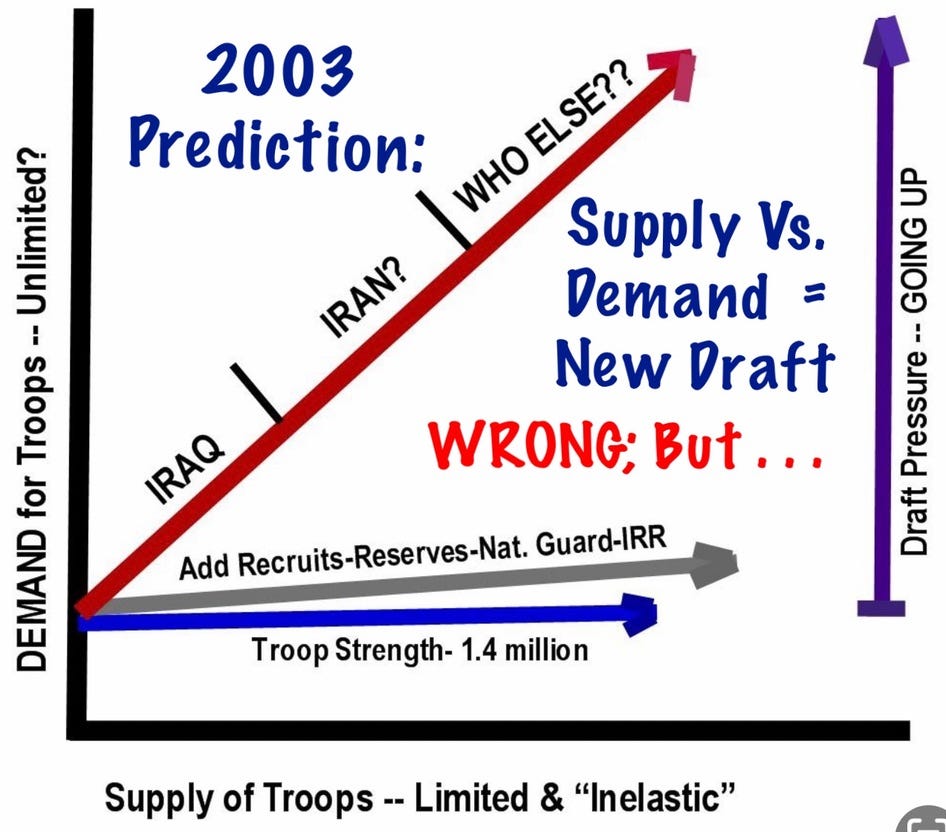
My conclusion was straightforward: soon demand would exceed supply. When it did, military leaders would be forced to overcome their post-Vietnam dread of conscription and ask Congress for a new draft.
The graph was simple.
My argument wasn’t the only one. A much more significant case was made by Army General Eric Shinseki, Chairman of the Joint Chiefs of Staff in 2002-3. He argued that to be effective, the Iraq invasion force needed to be “several hundred thousand” troops larger – more than twice as many as George Bush’s war planners were assembling.
Where would these troops come from?
Yeah, where?
Shinseki didn’t speak directly of the draft. But when he calmly repeated his numbers to a congressional committee in February 2003, it sparked a brief public outcry.
The math was simple. Yet the suits at the Pentagon and White House were determined to minimize U. S. casualties (& protests). Shinseki was quickly rebuked, overruled and benched. Bush went with the smaller force, different generals.
And the war became a bloody pointless fiasco/quagmire.
Shinseki’s candor, while career-ending, was vindicated, said The New York Times.
But when the draft did not then rise from its bureaucratic grave, my article didn’t attract any attention.
Even so, events also supported much of my argument, even if not the prediction.
The manpower gap I anticipated did emerge. And widened.
What happened instead of a draft was far more complicated—and in some ways more costly.
The years that followed saw exactly the kinds of strains I expected. Deployments multiplied. National Guard and Reserve units were repeatedly mobilized. Recruiting became increasingly difficult. Retention was a chronic concern. Military families endured long separations, repeated moves, and mounting stress.
But instead of a draft, the government found other ways to fill the gap.
Contractors took over functions once performed by uniformed personnel. Foreign auxiliaries and security firms expanded. Drones and remote technologies reduced some manpower requirements.
More importantly, existing troops were stretched and squeezed: deployed again and again. “Stop-loss” policies kept many from leaving the military when they expected to (and yes, such “captivity” was deemed legal). The burden was concentrated on a relatively small portion of the population rather than spread across society as a whole.
And one other important thing I missed was that the costs of this strategy, including the heaviest, could be essentially hidden.
Combat deaths were visible. The body of a soldier killed in Iraq or Afghanistan came home under military escort. There were ceremonies, hometown headlines, flags, and grieving families.
But many other costs were recorded elsewhere.
A veteran who survived combat but later took his own life was not counted as a casualty. Family breakdown, domestic violence, post-traumatic stress, moral injury, recruiting shortfalls, and retention crises appeared in separate reports and disappeared into separate bureaucratic silos. They were discussed as scattered individual problems rather than as symptoms of a military under severe systemic strain.
The result was a kind of accounting illusion.
The anticipated military manpower crisis did not go away. Instead, many of its consequences were redistributed, delayed, privatized, or hidden.
I watched this happen from close up, at Quaker House, in Fayetteville. We passed our 40th anniversary of work in those years; but the local impact of the stretch and squeeze obliged us to expand our work of counseling and advocacy to include domestic violence and what came to be called “moral injury.” That’s the damage done to spirits and souls of too many troops caught in a seemingly endless, and meaninglessly violent machinery which has no morals or virtue beyond what some now glorify as “lethality.”
This does not mean the all-volunteer force failed. In many respects it proved more resilient than I expected.
But it does suggest that the question I was asking in 2003 was not entirely misguided.
The real question was not simply whether Congress would revive conscription.
It was how the nation would respond when military ambitions exceeded the willingness of citizens to serve voluntarily.
For more than two decades, the answer was to stretch the existing force, supplement it with contractors, drones and other technology, and absorb and downplay the resulting social and human costs.
Now some of the same signs of strain are reappearing.
Recruiting remains difficult, despite administration PR fluff. Retention also lags in many critical specialties. Several European nations have recently moved back toward forms of conscription. Major-power competition has returned. Military planners increasingly discuss the possibility of simultaneous crises involving Europe, the Middle East, and East Asia, Venezuela, Cuba, and elsewhere.
Does any of this mean a U. S. draft is imminent?
Possibly; but I’m doubtful. Indeed, one lesson of the past twenty years is that governments possess many tools for postponing that outcome.
Yet the underlying dilemma has not been banished.
A nation can expand its military commitments. It can reduce the human visibility of war. It can shift burdens onto smaller groups of citizens. It can disguise costs in accounting categories and public-relations campaigns. It can turn to drones and weaponized AI.
But it cannot repeal arithmetic.
Sooner or later, military commitments and military humanity must balance.
At least, I think so.
Back in 2003, I thought that balancing point would necessarily produce a draft.
Those in charge thus far have trod a costly, but different path.
The question now is whether that path remains sustainable.
I have not seen or heard any credible advocacy for a new draft in reports from Congress. Perhaps that’s because there are only 100 veterans in the current 535 members of the 119th Congress. (That’s about one-sixth. In 1973, the ratio of Veterans in Congress was 3 out of four, 402 out of 535.) A new draft would require an act of congress, signed by the president. What this nearly draft-free assemblage thinks a possible draft ought to look like is not a politically polarized matter; it’s more like a complete mystery, to me, and I expect to most of them.
But there was an intelligent and forceful debate of its pros and cons at the Dole Institute at the University of Kansas in 2024, between retired military colonels and other scholars. A thoughtful summary of that discussion is here.
Lawrence Kansas may seem to be a long way from the Capitol and the Pentagon. But it’s just a few dozen miles from Fort Leavenworth. That’s where the Army’s Command and General Staff School puts the final polish on all their rising generals. So, what happens in that part of Kansas doesn’t stay there but shows up in the Pentagon and in the Capitol before long.
For my worried friends, with the Vietnam flashbacks and the doted-upon grand cousins, maybe there’s some comfort in my prophetic failure, and the words of the great seer Yogi Berra: “Predictions are hard, especially about the future.”